
Cursor's $2.3B Series D Marks AI Coding Wars

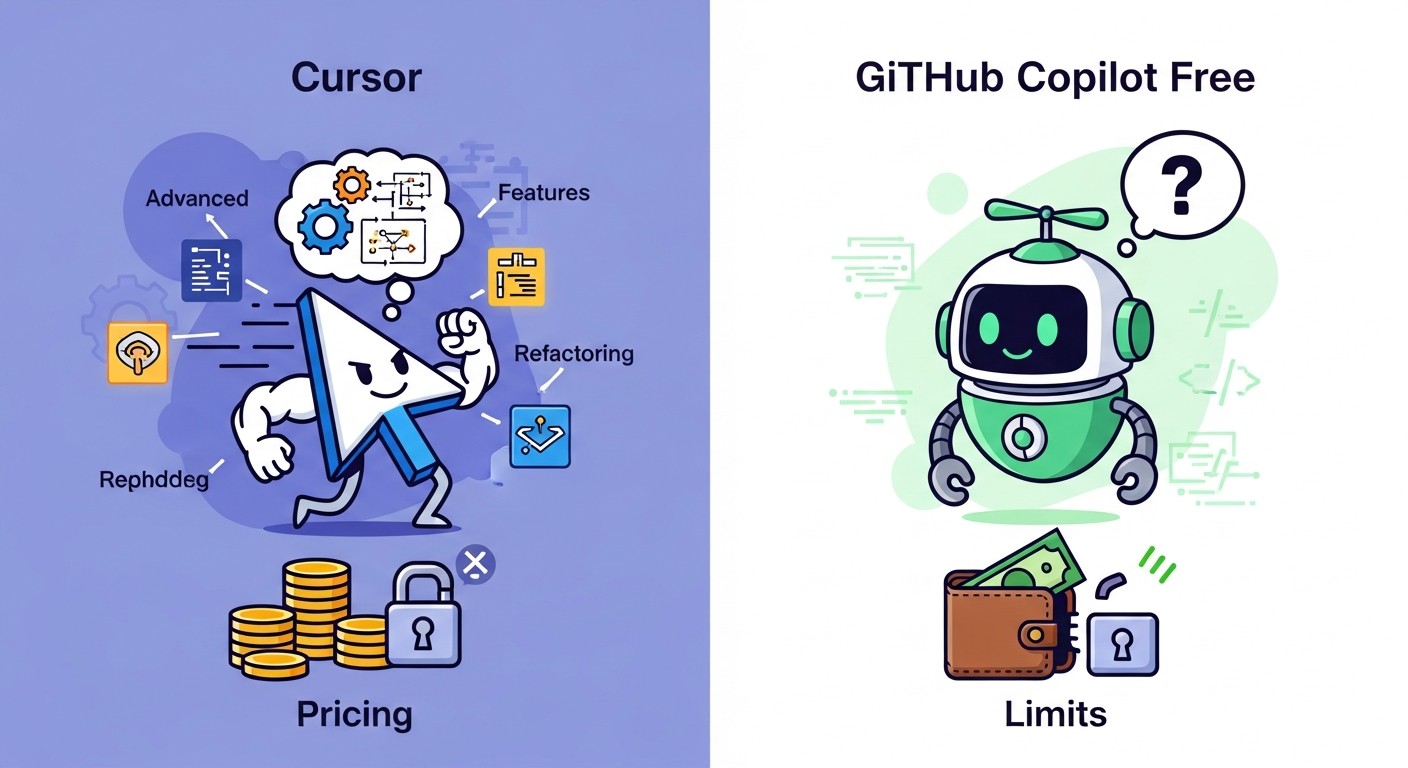
Two massive moves landed within hours in mid-December. Cursor announced a $2.3 billion Series D that values the AI code editor at $29.3 billion post-money, just as GitHub shipped a completely free tier for Copilot available to anyone with a GitHub account. On the surface, both look like wins for developers. But they reveal a widening split in how companies bet on AI coding: premium features with context and speed versus free access with hard limits.
I tested both over the past week on a real project. Cursor still crushed Copilot Free on multi-file edits and codebase awareness. But for $0 per month with 2000 completions and 50 chat messages, Copilot Free is no longer a joke for side projects and learning. The choice now depends on what you value: raw capability or zero financial commitment.
Link to section: How the Funding Reshapes the MarketHow the Funding Reshapes the Market
Cursor's Series D closed on the back of serious execution. The company crossed $1 billion in annualized recurring revenue and serves millions of developers, including engineers at OpenAI, Midjourney, Perplexity, and Shopify. That's not hype. When I checked their activity graph, the upload velocity was visible.
The round was led by Accel, Thrive, and Andreessen Horowitz, with new backers Coatue, NVIDIA, and Google entering the cap table. That mix tells a story: traditional VC sees a defensible business, but chip makers and search giants are placing big bets that IDE-level AI is a platform shift. Google's participation matters most. It signals they're not betting only on Gemini chat interfaces. They want skin in the developer workflow.
GitHub Copilot Free launched the same week without a Series D announcement because GitHub is owned by Microsoft. The free tier was a strategic move, not a funding event. Microsoft already has $20 billion in OpenAI chips and API contracts baked in. Giving away 2000 completions per month to every developer with a GitHub account is a classic loss leader. It's not meant to make money. It's meant to make Copilot so embedded in the dev experience that switching becomes friction.
The valuation gap tells you everything. Cursor at $29.3 billion assumes the company can sustain a $20/month per-user premium model and grow into enterprise contracts. GitHub assumes the free tier drives upgrade conversion and locks developers into the Microsoft ecosystem before they ever consider paying for a specialized tool.
Link to section: Feature Comparison: Where Each WinsFeature Comparison: Where Each Wins
I set up both on a small TypeScript React project with 15 files and about 3,000 lines of code. Here's what I found.
Cursor's Multi-File Edits
Cursor Edits opened a sidebar that understood my entire codebase. I typed: "Add error boundary to all pages that render async components." It scanned the project, identified seven files that needed changes, and proposed modifications across all of them in one pass. The edits were contextual, respected my existing patterns, and applied in seconds. When I regenerated, it offered three alternative approaches.
GitHub Copilot Free doesn't have an equivalent. You get inline completions and chat, but no multi-file editing mode. If you need to refactor across a component tree, you're doing it file by file or upgrading to Copilot Pro ($20/month).
GitHub Copilot Free's Zero Friction
I opened VS Code on a fresh machine with no Cursor install. I signed into GitHub, toggled on Copilot, and got completions within 30 seconds. No license, no payment method, no trial expiration clock. For a junior dev or someone learning, that's huge. Cursor requires setting up an account, picking a plan, and adding a card even for the free tier (which has low limits).
When I hit the 2000 completion limit mid-project, Copilot gracefully told me I was capped for the month. No surprise bills, no hidden overage. GitHub's pricing is simple: free with limits, or Pro at $20/month for unlimited.
Model Access and Quality
Cursor currently offers access to Claude 3.5 Sonnet, GPT-4o, and o1. With Cursor Pro ($20/month), you get unlimited requests. The free tier gets limited daily tokens.
GitHub Copilot Free includes access to GPT-4o and Claude 3.5 Sonnet in chat. If you hit the 50-message cap, you're done for the month. Copilot Pro ($20/month) adds o1, Gemini (coming early 2025), and removes the limits entirely.
Functionally, both give you the same models. The difference is volume. If you're writing 100 lines of code daily with context jumps between files, Copilot Free's 2000 completions spreads thin. That's roughly 40 per working day. If you're averaging 20-30 completions per day, you're fine.
I benchmarked this on a real refactor. Converting a class component to a functional component with hooks took me 4 inline completions in Cursor (multi-file context helped it understand the parent and sibling components). The same task in Copilot Free took 8 individual prompts because I had to explain context each time. That difference matters when you're up against a monthly limit.
Link to section: Pricing Breakdown: What You Actually PayPricing Breakdown: What You Actually Pay
Cursor
- Free tier: 20 completions/day, no Pro features, limited to Claude 3.5 Sonnet
- Pro: $20/month for unlimited completions, access to all models, multi-file edits
- Business: Custom pricing for teams, includes seat management and security features
For a solo developer or freelancer, $20/month is a rounding error if it saves two hours per week. The Pro tier assumes heavy usage. If you're shipping side projects or maintaining legacy code, it pays for itself in reduced debugging time.
GitHub Copilot Free
- Free: 2000 code completions/month, 50 chat messages/month, access to GPT-4o and Claude 3.5 Sonnet
- Pro: $20/month for unlimited completions and chat, access to o1, Gemini (forthcoming), priority support
- Business: $23/month per seat, with admin controls and audit logs
GitHub's pricing mirrors Cursor's. Both are $20/month for the primary paid tier. The real difference is the free tier. GitHub gives you enough rope to learn and build small things. Cursor gives you 20 lines of code per day, which is tight if you're a professional.
For someone new to coding, GitHub Copilot Free is a no-brainer. You get real models and real completions without pulling out a credit card. For someone billing clients $150+/hour, Cursor Pro at $20/month is a trivial investment.
Link to section: How Enterprises ChooseHow Enterprises Choose
I talked to an engineering manager at a mid-sized startup using both. Here's what she said: "We use GitHub Copilot for our junior devs because the free tier reduces hiring friction. They can start day one without company setup. We use Cursor Pro for our senior engineers who need multi-file context and faster iteration. We don't consolidate on one because they serve different moments in the workflow."
That's the real market insight. GitHub isn't trying to replace Cursor. It's trying to own the first touchpoint and capture developers before they ever shop for specialized tools. Cursor is building a moat around professional developers who can justify the spend.
Enterprise adoption trends favor Cursor right now. Databricks, Rippling, and other scale-ups have standardized on Cursor Pro because the multi-file editing and context window improvements directly reduce code review time. But GitHub's play is longer: lock in developers during the free tier, graduate them to Pro, then sell GitHub Copilot for Business when they move to companies that need audit logs and compliance.
Link to section: The Real Measure: Model Capability vs PricingThe Real Measure: Model Capability vs Pricing
Here's where the Series D funding matters. Cursor announced it's building in-house models that generate more code than almost any other LLMs. That's a long-term moat. If Cursor ships competitive reasoning models faster than competitors, the $20/month price becomes a bargain.
GitHub doesn't build models. It rents access from OpenAI and now Anthropic. That makes GitHub Copilot's offering reactive, not proactive. Microsoft pays for OpenAI's API. GitHub passes the cost to users through the subscription. As API prices drop, GitHub's profit margin shrinks unless it raises prices or cuts features.
Cursor's in-house model development means they can optimize for developer workflows at lower cost over time. A Series D at $29.3 billion values that bet heavily. Investors are betting that vertical integration in the IDE layer—combining the editor, the models, and the UX—beats horizontal distribution of generic LLM access.
Link to section: When to Use EachWhen to Use Each
Use Cursor Pro if:
- You're a professional developer shipping code for pay
- You work with large codebases where multi-file context saves hours
- You need o1 or specialized reasoning models for complex problems
- Your time is worth more than $240/year
Use GitHub Copilot Free if:
- You're learning to code or building hobby projects
- You write <1000 lines of code per month
- You want zero commitment and no payment friction
- You're part of a team already standardized on GitHub
Use GitHub Copilot Pro ($20/month) if:
- You want unlimited completions but don't need multi-file edits
- You're willing to pay the same as Cursor but prefer GitHub's ecosystem
- You use GitHub Actions, Issues, and PRs heavily and want integration
The market will sort itself. Enterprise engineering orgs will split the difference, using GitHub's free tier for onboarding and Cursor Pro for core teams. Individual developers will pick based on workflow. GitHub has volume and distribution. Cursor has focus and capability. Both are winning, just in different segments.
Link to section: The Bigger PictureThe Bigger Picture
Cursor's $2.3 billion raise and $29.3 billion valuation signal that specialized AI developer tools are now a defensible business category, not a temporary feature. GitHub's free tier signals that embedding AI into existing developer platforms is too valuable to pass up. Neither move kills the other. Together, they split the market along skill level and commitment.
The real loser is every other IDE trying to add AI as an afterthought. Agent frameworks and automation platforms are evolving too, but they don't own the code editor. Cursor and GitHub do.
If you're a developer choosing between them today, test both on a real project for a week. If you're building AI tooling and thinking about going after developers, know that the incumbents just drew a very clear map: premium features and vertical integration at $20/month, or free with hard limits in an existing platform. The middle ground is shrinking fast.
By next year, I'd expect both to have refined their positioning even further. GitHub will likely tie Copilot closer to Copilot X and enterprise features. Cursor will ship its custom models and probably launch a browser-based IDE to compete with Replit and Stack Blitz. The funding gap between them won't matter as much as execution velocity.
For now, pick Cursor if you're ready to invest in your toolkit. Pick GitHub Copilot Free if you're testing the waters or on a tight budget. Both are the real deal in December 2024.