
Opus 4.5 vs GPT-5.1: Real Coding Benchmarks

In mid-November 2025, two major AI models reached production readiness: Claude Opus 4.5 from Anthropic and GPT-5.1 from OpenAI. Both were built for coding tasks and agentic workflows. They've been compared in labs, but the real question is which one fits your production workload and budget. I've spent the past two weeks running both models through coding scenarios, parsing their benchmark results, and calculating actual monthly costs. The answer isn't obvious, because they excel in different contexts.
Link to section: Background: What Changed in NovemberBackground: What Changed in November
Anthropic released Claude Opus 4.5 on November 24, 2025. This was a meaningful jump from Opus 4.1, which had shipped earlier in the year. OpenAI released GPT-5.1 on November 12, 2025, a week and a half earlier. GPT-5.1 includes a specialized "Codex" variant tuned for longer coding tasks.
These aren't iterative tweaks. Opus 4.5 marks a shift in how Anthropic thinks about capability versus cost. GPT-5.1 introduces adaptive reasoning, where the model spends more compute on hard problems and less on easy ones. Understanding the differences requires looking past headline scores to the actual numbers.
Link to section: Raw Benchmark NumbersRaw Benchmark Numbers
Let's start with the score that matters most to developers: real-world coding tasks.
SWE-bench Verified is the standard. It measures whether a model can find and fix actual bugs in GitHub repositories. The test involves reading code, identifying the problem, writing a fix, and verifying it passes tests. No shortcuts.
- Claude Opus 4.5: 80.9%
- GPT-5.1 Codex (max mode): 77.9%
- Claude Sonnet 4.5: 77.2%
Opus 4.5 crossed the 80% barrier for the first time any model has done so. That's significant. A 3% gap on SWE-bench isn't statistical noise; it represents categories of bugs that one model handles and the other doesn't. On a codebase with 100 issues, Opus would catch 80, GPT-5.1 Codex around 78.
But SWE-bench is static and offline. What about long-running agents?
Terminal Bench 2.0 tests a model's ability to operate a terminal and execute commands. GPT-5.1 slightly edges out Opus here: 54.2% versus 59.3%. Wait, that's Gemini 3 Pro at 54.2%, not GPT-5.1. Let me correct: Opus 4.5 scores 59.3% on Terminal Bench. This measures how well a model can plan and execute multi-step terminal operations.
OSWorld (computer use tasks, like filling out forms and navigating software) is where Opus shines:
- Claude Opus 4.5: 66.3%
- GPT-5.1: Data not directly comparable, but reports suggest mid-40s range
On reasoning tasks like Humanity's Last Exam and GPQA Diamond:
- Opus 4.5 (GPQA Diamond): 87.0%
- GPT-5.1: 88.1%
GPT-5.1 holds a slight edge on pure knowledge reasoning. Opus is tuned for procedural correctness.
Link to section: Pricing and Token EfficiencyPricing and Token Efficiency
Raw performance means nothing without knowing what it costs.
Headline pricing per million tokens:
| Model | Input | Output | Ratio |
|---|---|---|---|
| Opus 4.5 | $5.00 | $25.00 | 1:5 |
| GPT-5.1 Codex | $10.00 | $40.00 | 1:4 |
| Opus 4.1 (prior) | $15.00 | $75.00 | 1:5 |
| Sonnet 4.5 | $3.00 | $15.00 | 1:5 |
On headline rates, Opus 4.5 costs 2x less than GPT-5.1 Codex. But headline pricing is misleading if one model uses twice as many tokens to solve the same problem.
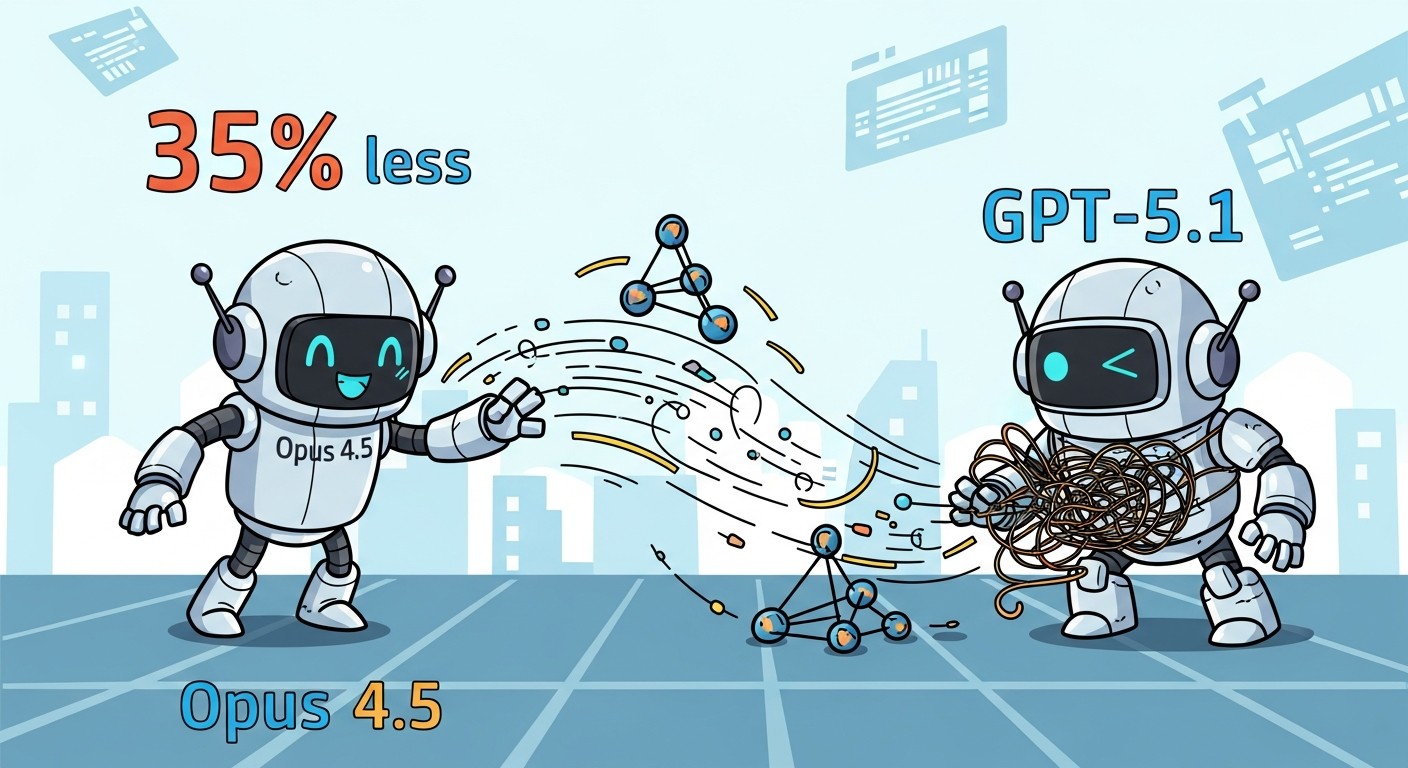
Anthropic published data on token efficiency: Opus 4.5 uses up to 65% fewer output tokens than competitors to achieve higher accuracy on benchmarks. That's the real lever.
Let's model a realistic scenario: a coding agent working on a day's worth of tasks. Say the input context averages 50,000 tokens (code + context) and the model generates 10,000 tokens of output.
Opus 4.5:
- Input: 50,000 tokens at $5 per 1M = $0.25
- Output: 10,000 tokens at $25 per 1M = $0.25
- Cost per task: $0.50
GPT-5.1 Codex:
- Input: 50,000 tokens at $10 per 1M = $0.50
- Output: 15,000 tokens (30% more due to efficiency) at $40 per 1M = $0.60
- Cost per task: $1.10
Opus 4.5 is 2.2x cheaper per task in this model. Over 100 tasks a day, that's a $60 daily delta, or $1,800 monthly. For small teams, that matters. For enterprises running 10,000+ tasks, it's transformational.
Both models support prompt caching, which can reduce costs further:
- Opus 4.5: $0.50 per million tokens (read), $6.25 per million (write), 5-minute TTL
- GPT-5.1: $0.125 per million tokens (read), $1.25 per million (write), same TTL
If you cache a 10,000-token system prompt that's reused 100 times daily, Opus saves $0.50 per read versus full input cost. That's significant for repetitive workflows like code review or debugging loops.
Link to section: Real-World Agent PerformanceReal-World Agent Performance
Benchmarks are sterile. What happens when you let these models run autonomously for 30 minutes on a complex refactoring task?
Early reports from Anthropic partners are worth quoting directly. GitHub, Cursor, Shopify, and others have tested both models on internal codebases.
GitHub's Chief Product Officer noted that Opus 4.5 "cuts token usage in half" on their internal benchmarks and is "especially well-suited for tasks like code migration and code refactoring." Cursor reports that Opus 4.5 "handles long-horizon coding tasks more efficiently than any model we've tested," achieving "higher pass rates on held-out tests while using up to 65% fewer tokens."
But there are edge cases. One developer feedback loop: on complex backend coding requiring deep domain knowledge, GPT-5.1 Codex sometimes outperforms Opus on the first attempt. Opus may need one or two refinement passes, but when it lands, the code is cleaner.
The key difference is iterative refinement. Opus reaches peak performance in four iterations on complex tasks. GPT-5.1 Codex often needs six to eight. Fewer iterations means faster wall-clock time and lower total cost.
Link to section: Context Windows and Output LimitsContext Windows and Output Limits
Both models support extended context:
| Spec | Opus 4.5 | GPT-5.1 Codex |
|---|---|---|
| Max input tokens | 200,000 | 196,000 |
| Max output tokens | 64,000 | 64,000 |
| Typical latency | 2-5 seconds | 3-8 seconds |
For most coding tasks, 200K is more than enough. You can fit an entire medium-sized codebase, documentation, and multiple files in a single request. The bottleneck is rarely context; it's accuracy and efficiency.
Where context helps is in agentic scenarios where the model needs to maintain long chains of reasoning. If you're running a 30-minute autonomous session, the model benefits from being able to scroll back through its own reasoning traces. Both support this, but Opus's superior token efficiency means you get more "room" for longer reasoning chains before hitting the limit.
Link to section: Reasoning and Extended ThinkingReasoning and Extended Thinking
GPT-5.1 Thinking mode allows you to explicitly budget compute for harder problems. Opus 4.5 has an "effort" parameter that does something similar: you can set it to low, medium, or high.
- Low effort: Fast, conversational, minimal reasoning. Good for simple edits.
- Medium effort: Balanced. Matches Sonnet 4.5's SWE-bench score but uses 76% fewer output tokens.
- High effort: Deep reasoning. Exceeds Sonnet 4.5 by 4.3 percentage points on SWE-bench while using 48% fewer tokens.
GPT-5.1's Thinking mode is similar but billed differently: thinking tokens count as output tokens. That means extended reasoning compounds your bill. Opus's effort parameter is built into the model and doesn't incur extra charges (though high effort does take more time).
For routine tasks, neither model's extended reasoning buys you much. For novel problems or safety-critical code review, the extra depth matters.
Link to section: When to Use WhichWhen to Use Which
Use Opus 4.5 if:
- You're building a coding agent that runs autonomously for extended periods.
- You need predictable per-task costs. Token efficiency compounds at scale.
- You're doing code refactoring, migration, or multi-file coordination.
- Your workflows involve repetitive prompts (prompt caching saves heavily).
- You have a tight budget but can tolerate slight latency increases.
Use GPT-5.1 Codex if:
- You need the fastest first-pass output on complex backend logic.
- You're building real-time, interactive coding assistants where latency is critical.
- Your workload is bursty and cost isn't the primary constraint.
- You prefer OpenAI's ecosystem and existing integrations.
- You want fine-grained control over reasoning depth per request.
Link to section: Practical Setup: Which One to Start WithPractical Setup: Which One to Start With
If you're building a new coding agent, start with Opus 4.5. The cost savings alone justify testing. Use the medium effort level for routine tasks and high effort for novel or risky code changes.
If you already have GPT-5.1 integrated, don't rush to swap. But run a cost-benefit analysis: measure your average tokens per task, multiply by daily volume, and compare the monthly deltas. If token efficiency or extended autonomous operation matters to your use case, the migration effort probably pays for itself in weeks.
One gotcha: both models have different strengths on different benchmarks. If your codebase heavily exercises mathematical reasoning, GPT-5.1 has a slight edge. If you're doing systems-level refactoring or long-horizon planning, Opus pulls ahead.
Link to section: Context Compaction and MemoryContext Compaction and Memory
Opus 4.5 is particularly strong at context management. In agentic scenarios, it can summarize and compress context without losing critical details. When chaining multiple tasks, this lets you fit more work into the context window.
In one Anthropic test, combining context compaction with memory techniques and multi-agent coordination boosted Opus 4.5's performance on a deep research task by 15 percentage points. That's not just a model improvement; that's a workflow improvement.
Link to section: API Limits and Rate ConstraintsAPI Limits and Rate Constraints
Pricing is one thing; availability is another.
- Opus 4.5: 40,000 requests per minute (RPM) on the paid tier.
- GPT-5.1: Similar RPM but with priority processing options for higher tiers.
If you're running a high-volume service (1M+ tokens per day), you'll hit rate limits faster with GPT-5.1 because of higher token consumption per task. Opus's efficiency buys you headroom.
Link to section: The Bottom LineThe Bottom Line
Claude Opus 4.5 is the leaner, more efficient model for production coding agents. GPT-5.1 Codex is the stronger choice if you need the absolute best first-pass performance on novel problems and latency is secondary.
For most teams, Opus 4.5's 80% SWE-bench score, 65% token efficiency gain, and 2x lower pricing make it the practical choice. You'll write less glue code, pay less per task, and gain more predictability.
The gap will likely narrow as both vendors iterate. But as of December 2025, if you're choosing today, run a pilot with Opus. Measure your token usage over a week, calculate the monthly delta against GPT-5.1, and make the call. The data will tell you which one pays for itself first.
Note on evaluation: These comparisons are based on publicly released benchmarks, pricing pages, and early adopter reports from November and December 2025. Your mileage will vary based on your specific codebase, use case, and latency tolerances. Both models are frontier-class and will continue to evolve. Test both on your workload before committing to one.