CES 2026 Humanoid Robots: Atlas vs CLOiD Comparison
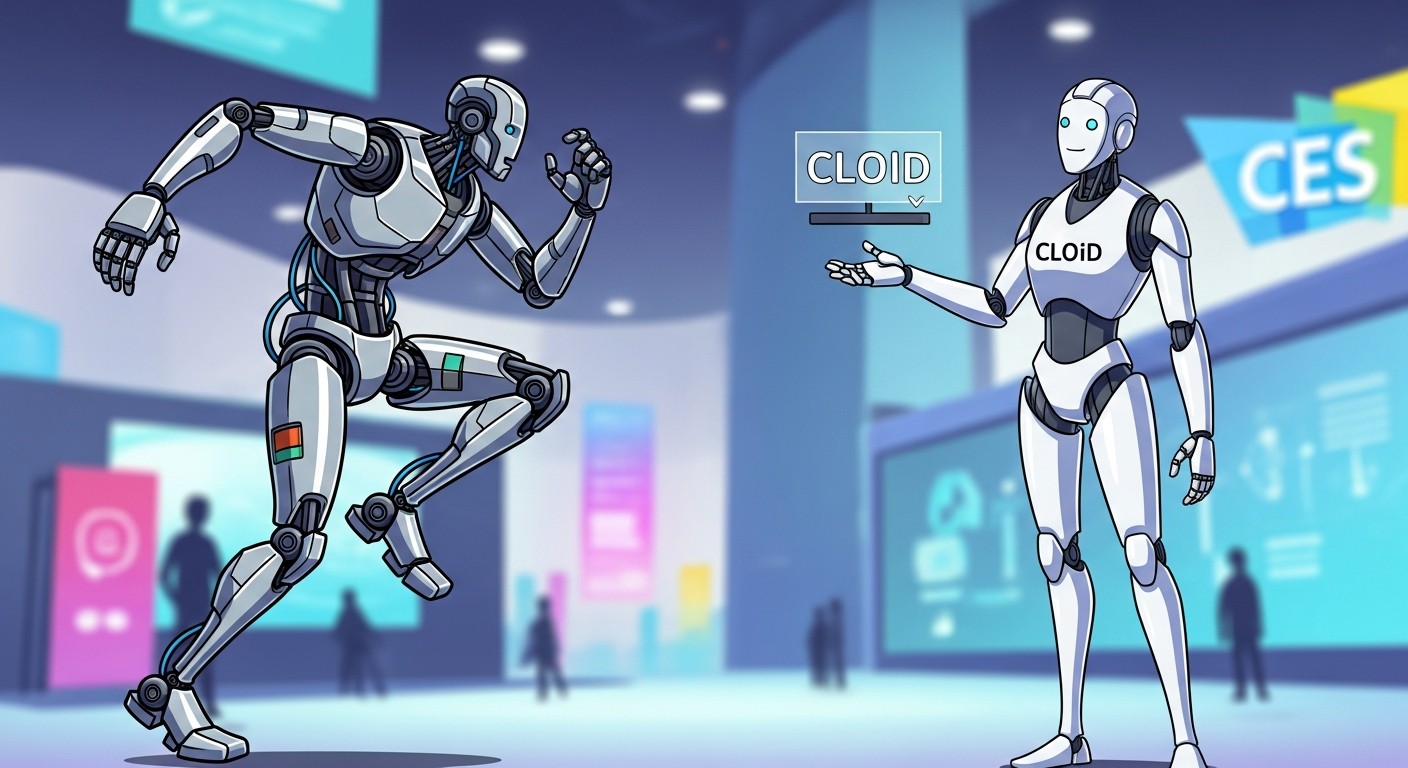
CES 2026 was supposed to be about AI software. Instead, it turned into a showcase for robots that actually work. For years, humanoid robots existed in two states: either impressively acrobatic research platforms that couldn't assemble a car door, or vaporware concepts with no path to production. This year was different. Boston Dynamics announced that Atlas is in full production. LG showed CLOiD folding laundry in a real home setting. NEURA Robotics unveiled a humanoid designed with Porsche. Unitree demonstrated their G1 executing martial arts movements on the showfloor. For the first time, the question isn't whether humanoid robots can work. It's which one you'll buy and when.
I spent three days at CES walking between the robotics sections, comparing specs, and talking to engineers. Here's what separates the contenders and why timing matters more than raw capability right now.
Link to section: Boston Dynamics Atlas: The Production LeaderBoston Dynamics Atlas: The Production Leader
Boston Dynamics took the headline slot by announcing that Atlas has moved from research platform to production hardware. After 15 years of demos, backflips, and YouTube virality, the company is actually building robots for factories.
The production Atlas is fully electric, which marks a major departure from the hydraulic design the company used for over a decade. The specs tell the story of a machine built for industrial work, not acrobatics. The robot stands 1.5 meters (4.9 feet), weighs 89 kg, and can lift 110 pounds instantly or sustain 66 pounds over time. It has 56 degrees of freedom spread across 28 joints, giving it precision that earlier versions couldn't match. The reach extends to 7.5 feet, covering a typical car assembly workstation without repositioning.
The first deployment is at Hyundai's Georgia EV assembly plant in 2028. Hyundai will start with parts sequencing, then graduate to component assembly by 2030. Google DeepMind is getting Atlas units to integrate Gemini Robotics foundation models into the control stack, which suggests the next iteration will include reasoning layers for unstructured tasks.
Boston Dynamics has been coy about pricing, but third-party estimates place the production unit around $150,000 to $200,000 per robot once volume production starts. For automotive manufacturing, where a single line requires multiple robots and operates 24/7, that math works. A robot working one shift pays for itself in two years on labor savings alone.
The real unlock for Atlas is software. Earlier versions were brittle; they relied on precise, predefined sequences. The new version integrates NVIDIA's Isaac GR00T foundation model, which lets the robot generalize across tasks without hand-coded routines for each variation. That's not magic, but it's a meaningful step past "play recorded motion."
Link to section: LG CLOiD: The Home Robot BetLG CLOiD: The Home Robot Bet
LG's strategy is the inverse of Boston Dynamics. Instead of factories, LG is targeting homes. Instead of one specialized task, CLOiD tries to do many. The company calls it the "Zero Labor Home" vision.
CLOiD has a mobile base, two seven-DOF arms, and a head that functions as an AI hub housing cameras, LiDAR, and voice processing. The robot stands 1.7 meters tall and weighs around 50 kg, making it mobile enough to fit through standard doorways. At CES, LG demonstrated CLOiD folding laundry, loading a dishwasher, preparing ingredients for cooking, and patrolling a home for security anomalies. None of the demonstrations were perfect. The folding was deliberate rather than fast, and the cooking prep required a prepped environment. But for a first-generation product, the breadth was striking.
LG hasn't released pricing, availability, or definitive specs beyond what appeared in live demos. The company is cagey about timeline, suggesting "sometime in the future" rather than a specific year. That's typical for first-generation home robotics; companies often announce too early and face backlash when the product takes longer than expected.
The software model is different from Atlas. CLOiD relies on LG's ThinQ smart home ecosystem. The robot can control compatible appliances, ask for clarification via voice, and learn household routines over time. It's less "let's teach this robot a new motion" and more "let's train it on the specific layout and habits of this home." That approach limits portability but increases utility in a single environment.
The challenge for LG is that home robotics is a harder problem than factory robotics. A factory has one layout, one set of tasks, and controlled lighting. A home has hallways of varying width, unpredictable clutter, and family members who don't follow rules. The demos showed CLOiD handling specific, staged scenarios. Sustaining that in a real home for months is a different test.
Link to section: NEURA Robotics Gen3: Dexterity Over GeneralityNEURA Robotics Gen3: Dexterity Over Generality
NEURA Robotics unveiled the Gen3 humanoid, co-designed with Porsche Design Studio. The aesthetic shift is immediate; it looks less like a research robot and more like a product. The physical design emphasizes dexterity and human collaboration. The robot has a 100-Nm torque capacity in its grippers and a patent on proximity detection that reduces collision injuries during shared tasks.
NEURA Gen3 incorporates NVIDIA Jetson Thor for onboard compute and runs GR00T N1.6 for reasoning. The company is positioning the robot for both industrial and domestic tasks, which is ambitious. The robot can manipulate delicate objects with tactile feedback or handle heavy loads in a warehouse. At CES, the robot demonstrated laundry folding (like CLOiD), but also performed dexterous tasks involving small components and intricate placement.
Pricing starts around $300,000 per unit for pilot deployments. NEURA is targeting logistics, healthcare, and light manufacturing as initial verticals. The company has raised sufficient capital to enter limited production in 2026, with plans to scale volume in 2027. Deployment is happening in Japan, Germany, and select US facilities.
The philosophy is different from both Atlas and CLOiD. NEURA isn't betting on one killer market. Instead, the company is providing a platform and letting customers adapt the software stack to their needs. That's a longer sales cycle but potentially higher lifetime value per robot.
Link to section: Unitree G1 and H2: Mass Market AmbitionUnitree G1 and H2: Mass Market Ambition
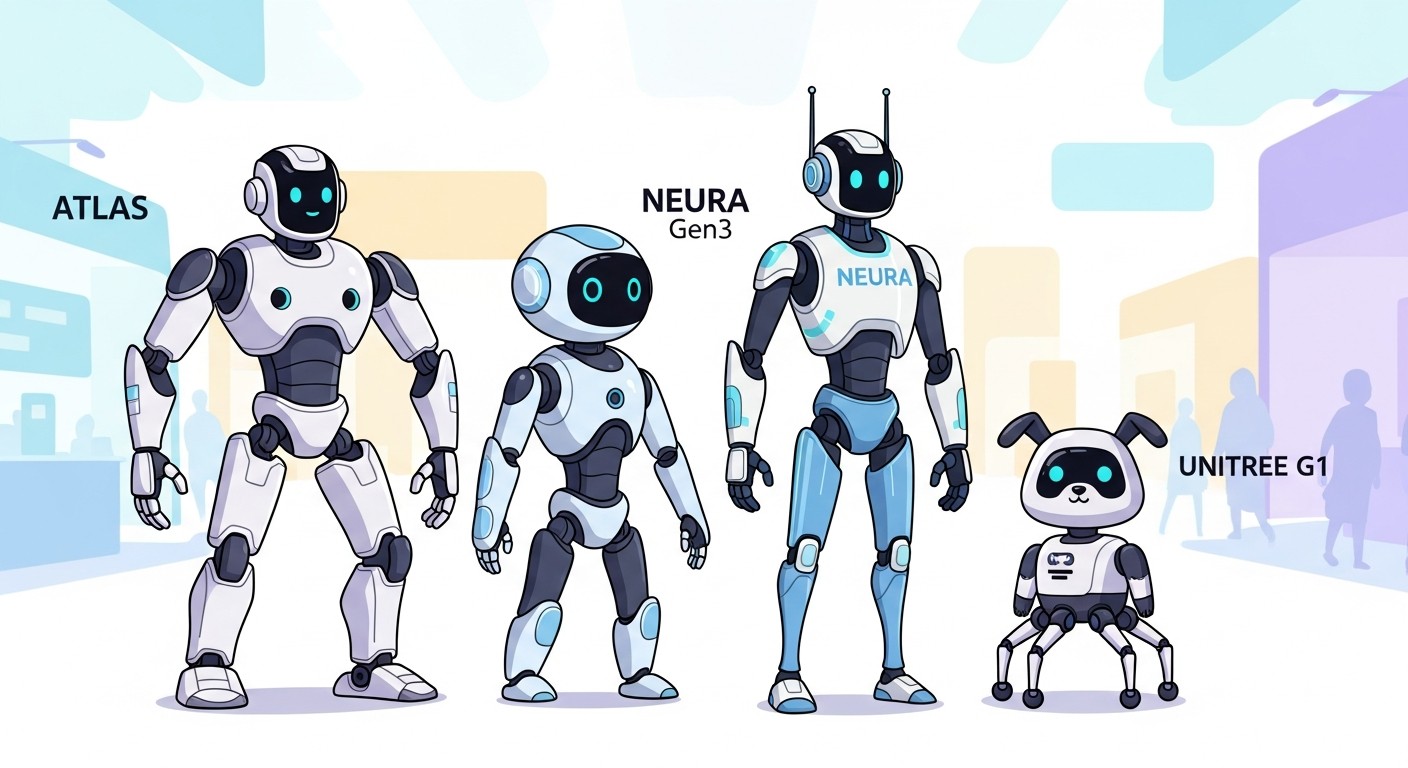
Unitree Robotics presented a full lineup: the G1 (compact, foldable, ~40 kg), and the H2 (larger, industrial-grade, ~55 kg). The company demonstrated the G1 performing martial arts routines and executing rapid transitions between tasks. The speed and agility exceeded earlier Boston Dynamics clips in some respects, though the tasks were less grounded in real industrial work.
Unitree's pitch is volume and price. The G1 is targeted at research labs, education, and early adopters at around $150,000. The H2 targets factories and logistics at roughly $250,000. By positioning two SKUs, Unitree is hedging: if consumers prove willing to adopt home robots, the G1 gets a second market. If the near-term wins are industrial, the H2 is ready.
The company announced a shift to a Robot-as-a-Service (RaaS) model for certain deployments, meaning customers pay a monthly fee for access to the robot, maintenance, and software updates rather than owning the hardware outright. That model reduces capital barriers for smaller manufacturers and service companies, which could accelerate adoption.
Link to section: Specification ComparisonSpecification Comparison
Here's how the robots stack up on key metrics:
| Metric | Atlas | CLOiD | NEURA Gen3 | Unitree G1 |
|---|---|---|---|---|
| Height | 1.5m | 1.7m | 1.75m | 1.25m |
| Weight | 89 kg | ~50 kg | ~52 kg | 40 kg |
| DOF | 56 | ~40 | 42 | 38 |
| Lift capacity (instant) | 110 lbs | ~30 lbs | 44 lbs | 22 lbs |
| Lift capacity (sustained) | 66 lbs | ~15 lbs | 26 lbs | 11 lbs |
| Runtime per charge | ~8 hours | ~6 hours | ~4 hours | ~10 hours (advertised) |
| Estimated cost | $150K-200K | Not disclosed | $300K | $150K-250K |
| Production timeline | Q2 2026 | Q4 2026 (speculated) | Q1 2026 | 2026 |
| AI foundation model | NVIDIA Isaac GR00T | LG proprietary | GR00T N1.6 | Proprietary |
| Primary use case | Industrial assembly | Domestic tasks | General purpose | Research, logistics |
The table shows specialization. Atlas is optimized for lifting and sustained industrial work. CLOiD prioritizes dexterity and multi-task versatility in tight home spaces. NEURA balances industrial strength with collaborative features. Unitree bets on speed and reach through volume.
Link to section: Why 2026 Is DifferentWhy 2026 Is Different
For the past decade, humanoid robots arrived at CES, impressed for three days, then disappeared into research labs. This year, the math worked. Three factors aligned: foundation models that generalize across tasks, edge AI hardware (Jetson Thor, NVIDIA Blackwell) that runs reasoning on the robot itself, and manufacturing partnerships with real deployment commitments.
Boston Dynamics isn't announcing a vague future. Hyundai has allocated floor space and written purchase agreements. NEURA has paying pilot customers. LG isn't burning venture capital; it's using corporate resources to place a bet in its existing smart home ecosystem. Unitree is raising capital backed by demonstrated interest from manufacturers in China, Japan, and Europe.
Second, the software stack matured. NVIDIA's open-source GR00T foundation model means smaller companies don't need a decade of robotics research to build a usable platform. A startup with $50 million and strong engineering can now productize a robot in 18 months instead of five years. That acceleration is already showing in the number of new robotics companies backed by major AI talent moving from research to hardware.
Third, deployment constraints are clearer. Atlas targets one scenario: assembly-line manufacturing. CLOiD targets one scenario: homes. NEURA targets verticals with defined workflows. The days of "our robot can do anything" are over. Specificity is credibility.
Link to section: Practical Deployment: What Matters NowPractical Deployment: What Matters Now
If you're a manufacturer evaluating these robots, here's what to focus on in 2026.
First, integration cost exceeds hardware cost. A $150,000 robot sitting in a factory does nothing. Integrating it into your production line, training staff, and building the monitoring infrastructure costs another $200,000 to $400,000. Boston Dynamics and Hyundai are tackling this together, which reduces your risk if you're Hyundai but increases it if you're a smaller OEM. NEURA and Unitree are more neutral platforms; you own the integration cost but also own the software roadmap.
Second, software updates matter more than hardware specs by 2027. A robot with GR00T N1.6 today will be outdated when N2 drops in six months. Your supplier's ability to push updates over-the-air, maintain backward compatibility, and provide fine-tuning tools directly impacts your utility timeline. Boston Dynamics, with Google DeepMind backing, has a clear advantage. NEURA and Unitree are newer to this model; expect some friction.
Third, supply chain risk is real. NVIDIA's Jetson Thor is the compute platform for most production humanoids announced today. If Jetson Thor supply tightens (or geopolitical factors restrict availability), every robot on your factory floor shares the same constraint. Diversification to alternatives like Qualcomm's Dragonwing or custom ASICs takes years. Start thinking about this now if you're planning a 2026-2027 rollout.
Link to section: Limitations No One MentionsLimitations No One Mentions
The robots showcased at CES all had handlers, staged environments, or both. Real environments are messier. A factory line runs 24/7; demos run 15 minutes per shift. CLOiD folds laundry in a demo home; your home has shoes, toys, and socks that don't match the training set. The robots are good, but they're not general. Vendors are understandably marketing the upside and downplaying the catch.
Also, these robots lack true autonomy on a timeline. They follow learned policies or teleoperator guidance. They don't walk into a new facility, assess the environment, and optimize work without human instruction. That's coming, but not in 2026. Expect a period of 18 to 36 months where each deployment requires 3 to 6 months of bespoke integration.
Finally, the economics are tight. A $150,000 robot saves labor, but only if your labor market supports ROI. In markets where wages are <$20 per hour, the breakeven period is 6+ years. In markets where wages are $50+ per hour, breakeven is 18 months. Atlas works in wealthy countries with labor constraints; it's a harder sell in labor-abundant regions.
Link to section: Looking AheadLooking Ahead
By 2027, expect three outcomes. First, Boston Dynamics will report real deployment data from Hyundai. If Atlas performs, other automakers will follow. If there are surprises, the entire industry recalibrates. Second, LG's home robot will either launch or get quietly shelved. If it launches, expect a wave of consumer robotics startups to follow. If it flops, home robotics gets harder to fund for a few years. Third, NEURA and Unitree will have each deployed 50 to 200 units and will know which verticals work and which don't.
The robots you see today are not the ones you'll buy. But they're no longer science fiction. They're prototypes moving from labs to factories. In 2026, that's progress enough.